Authors: Mastoureh Mobarez
I am Maryam (pseudonym), one of the girls who has spoken out against the Taliban’s misogynistic group and I have been living in Pakistan for four years. The fear of imprisonment and the repression of the Taliban made me abandon my life in Afghanistan and flee. These four years were filled with countless challenges for me, from Taliban warnings to immigration hardships and the threat of deportation by the Pakistani government.
Initially, I lived with my family members in Islamabad and tried to continue my civic activities, but my life was between fear and coercion. Until the Pakistani government imposed restrictions on Afghan refugees, in August 2025, visa extensions were halted, and educational and recreational activities such as English and computer courses, and even going to parks, became impossible for us. Despite this, I participated in protest programs with a thousand fears and chanted slogans against the Taliban.
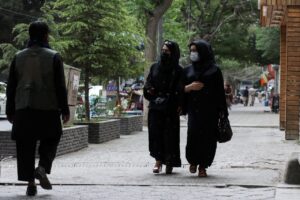
As time passed, the restrictions became tighter and door-to-door searches of the police began. We lived on Sir Sayed Street, where many Afghan immigrants lived, and we were more likely to be arrested every day. In December of that year, we had to flee to Peshawar. The path was full of checkpoints and dangers; we picked up a few things and tried to hide ourselves with our cloaks and black masks. We arrived in Peshawar at 9 p.m., but the new life was not easy either.
In Peshawar, we were forced to live like the people there, dressing like them and trying to behave the same way so as not to attract attention. In the courtyard where we live, we don’t talk loudly and we never play Afghan songs. Even laughing out loud seemed dangerous to us. I have learned to diminish our presence, as if we had to be invisible in order to survive.
The water here is sandy and a little salty. The first time I drank it, it tasted foreign to me. But now I’m used to boiling it and then drinking it, like so many other things that we had to deal with.
The people of Peshawar are different from Islamabad and mostly speak Pashto, a language I didn’t know and only knew Urdu. Every time I went to the bazaar, they would ask everyone from the taxi to the shopkeeper, “Where are you from?” and I had to say with little knowledge of Pashto that I was from “Gilgit” or “Chitral” so that they wouldn’t ask the second question.
Here, it is customary among the people to bring bread to the new neighbor and to greet them. But we didn’t open the gate. We hid ourselves for fear of being identified. Finally, one day, a woman knocked on the door so much that we had to open it. My brother, who knew a little Pashto, went to say that the women were not at home and answered in the negative with an apology. Even kindness had taken on a threatening hue for us.
One day, when my sister and I went to the supermarket and inadvertently spoke Persian, all eyes turned to us. At that moment, we realized that a young man was chasing us. Perhaps he wanted to find our home, because the Pakistani government has set a reward of “10,000 rupees” to identify Afghans. We changed lanes and hurried to a restaurant to make sure he stopped chasing. After that, we didn’t go out of the house for two weeks, and my father brought us dry bread and soup at night.
But the hardest moments were when we were afraid to even go to the hospital. One night, my mother’s blood pressure reached 140 and she was not feeling well, but we did not take her for fear of being detected in the hospital and reported to the police. We had a tough night with the medication the doctor had prescribed. Another night, my sister was burned with fever and tremors until dawn, but we still didn’t dare to go out. We just sat in the darkness of the house, prayed, and waited with fear for the dawn. Today, life is hard and exhausting for me; arrests have intensified in Pakistan, and the Taliban continue to pose a threat of returning to Afghanistan. We sold the family’s property to cover our living expenses, but life is impossible both in Pakistan and in Afghanistan. Every day, the fear of deportation and imprisonment torments my mind and soul, and I don’t know what my fate will be.
My life has collapsed since the Taliban’s return, but despite all this fear and pressure, I still raise my voice. Because silence, for me, is a gradual death.
Photo credited: Internet