Part II
Written by Hassan Reza Khawari, Translated by Shekib Jaghori
2.1.2 – The Intensified Ruin of Women and the Silence of History
Afghanistan’s political history, at least in the last few centuries, has been built on a foundation of tribal systems, a plunder-based economy, and an ideological faith system. These three foundational structures have not only determined the structure of governance but have also shaped the social, economic, cultural, and psychological lives of the people. From peasant life to trade to nomadic pastoralism, the traces of tribe, plunder, and faith are evident in actions, values, and social relations. The peasant cultivates and produces, the trader exchanges and mediates, the nomad plunders, and the state is complicit as it benefits from all three. It claims sovereignty, shares in informal power, and suppresses dissent.
It is therefore not merely a formal order but a historical mindset and collective psychology in which power is distributed not according to law but through occupation, lineage, and tribal affiliation. In Ibn Khaldun’s view, the inner mechanism of this existence can be explained by the logic of tribal solidarity (asabiyyah), the desire for domination, and the circulation of power among dominant tribes. The historical consequence of this logic is nothing but the reproduction of structural violence and the systematic erasure of voices that lie outside the tribe.
Within this structure, a gendered division of space and meaning has become firmly entrenched. The social world is divided into two fundamental spheres:
1. The private sphere (the home): a space of silence, dependence, and obedience, where women are confined.
2. The public sphere: a domain of discourse, competition, and power, dominated by men and forbidden to women.
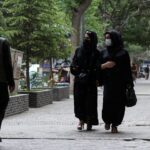
Inside the home, women are seen as symbols of order and discipline; outside, they are viewed as threats and sources of insecurity. Not only is their physical safety denied in public space, but their symbolic and semantic presence is also stripped away. Women are not only invisible on the streets but are also silenced and erased from language, history, and collective identity.
In such a society, history is not the narrative of the people, but a monologue of power. Consequently, it is not a ‘people’s chronicle’ that has emerged, but a ‘royal epic’ that has captured hearts. The stage of history is not a platform for dialogue between the people and their rulers, but a podium for the monologues of autocrats and the silence of the masses. Basically, the government speaks while the people remain silent and obey. When the people have spoken out, it has been either in the form of rebellion or in the form of poetry, mostly praising those in power or expressing vague, irrelevant sentiments. The result is that our official history is centred around the pronouncements of kings and the exploits of warriors, leaving out the struggles of the common people and the silence of the oppressed. Within the persistent silence of the masses, a distinct silence has emerged that is experienced primarily by women.
Women have not only been excluded from political and economic power, but also denied the ability to speak, to narrate, and to give meaning to themselves. Violence against women has persisted throughout history as a chronic and silent reality, rarely spoken about and rarely heard when women have raised their voices in protest. This reality is not only the result of overt repression; it also comes from a kind of cultural deception. Violence has been made to appear gentle, acceptable, even beautiful through things like romantic poetry, misogynistic myths, and male-centered religious values. Love, which should be a space for liberation and the celebration of difference, has, through cultural and literary traditions, become a means of beautifying a woman’s degraded position. Violence, wrapped in the appearance of affection and the image of the ideal beloved, has been normalized and allowed to continue. As a result, the degradation of women has become both desirable and enduring, internalized and nearly invisible.
2.2 The Cultural Structure of Women’s Ruin
2.2.1 – The Sharia of Discrimination and Violence Against Women
“How beautiful and how painful it is to be a woman!” — Ghada al-Samman
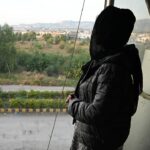
Afghan society was never founded on civil contracts or principles of justice and equality. Rather, it is rooted in tribal systems and ancient authorities. This system has pushed women out of public life and confined them to small spaces known as “Harams” or sanctuaries. These sanctuaries are soft prisons, fortified not by iron bars but by customs, fear, shame, and tradition. They mark the boundaries of prohibition and the walls of domestic imprisonment for women.
While these sanctuaries originally served symbolic and protective purposes, especially for defending against marauding tribes, over time they transformed into rigid social and political mechanisms. These mechanisms condemned women to disappearance and historical silence and erased their voice and presence from the realm of speech and power in society.
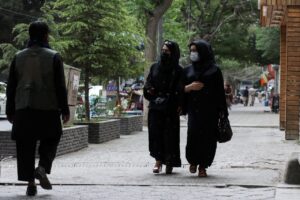
In these structures, women are defined as “awrah” (an Islamic term referring to parts of the body and voice considered private and forbidden to be seen or heard by non-mahram men). This term has two devastating consequences: It silences their voices and erases their presence, further entrenching their historical invisibility. Women are prohibited from showing their faces or making their presence known. They are not only forbidden from speaking themselves but also forbidden from being spoken about. They have no voice and no audience. Categorising a woman’s voice as haram (forbidden) because it is considered non-mahram serves a dual purpose: it deprives them of the right to speak and prohibits others from engaging with them. By excluding women from the realm of language, the Taliban effectively erased them from the world. Language is not only a means of expression, but also a reflection of one’s own existence. A world in which women are voiceless and faceless is fundamentally flawed, incomplete, and riddled with subtle but pervasive discrimination. This is the most egregious form of gender apartheid that the Taliban have enforced in Afghanistan under the guise of their self-proclaimed supreme leader.
In this framework, violence against women is not just an incident but an integral part of the social structure. This structure operates covertly and is deeply institutionalised, often disguising itself in a seemingly beautiful and cultural guise at different points in history. When violence is hidden, it becomes stronger and more brutal. Because it is invisible, it is not questioned, and because it is not questioned, it is perpetuated and continued. In such a world, women are not only victims of violence, but also victims of ignorance and silence about this violence. This ignorance and silence is rooted in patriarchal structures that are reinforced by religious backing. From this perspective, women are not concerned with territorial conquest or land appropriation, but with the appropriation of language itself. Women are denied language, and as they are silenced, they are deprived of the knowledge and ability to fight for a fundamental change in their status.
Contrary to what often happens in practise, violence cannot be answered with violence. Retaliation only perpetuates the cycle of violence. The alternative to violence is not revenge, but justice, and justice cannot be achieved without knowledge. The realisation of justice requires an understanding of its principles so that it can be interpreted and applied correctly. This is because injustice has sometimes been disguised as justice. The Afghan rulers have labelled their crimes as justice and not oppression! Distinguishing between true justice and injustice therefore requires knowledge and critical awareness. Moreover, knowledge cannot be acquired in isolation or seclusion, as some mystical traditions or domestic norms suggest. True knowledge requires engagement in the public sphere, where voices are heard, the world is shaped and meaning is created.
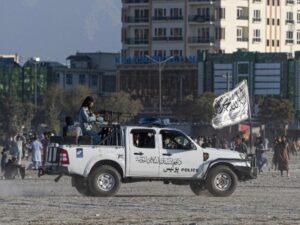
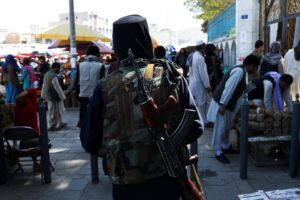
The prohibition of women’s participation in social and civic life systematically denies them access to knowledge, expertise, and the pursuit of justice. Women’s silence is not a divine decree or a natural phenomenon; it is the cumulative result of historical systems that have deliberately sought to prevent women from acquiring knowledge, asking questions, or challenging the patriarchal order. This profound silence has reached its peak with the rise of the Taliban regime, which is the modern manifestation of a millennia-old tradition of religious authoritarianism. This despotism is no longer confined to the ornate halls of royal palaces but manifests itself in the closure of schools, the imposition of strict uniforms, the presence of firearms and yellow barrels, excessive threats, and decrees that enforce silence, require veiling, and reduce women to a state of“awrah”.
The ban on girls’ education and women’s work is not just a political or religious decision, but a civilizational declaration: a declaration that celebrates the silence, speechlessness, and powerlessness of women and glorifies their extermination in a manner similar to the extermination of pests. The tragedy does not lie in the enforcement of these prohibitions, but in the fact that resistance to them does not arise from within religion, but only from outside. Which religious scholar has declared this policy “un-Islamic”? Which theologian has labeled it “heresy”? This religious silence is part of the same history of silence that reveals the complicity of those in power.
So, the central question is: How can we break this silence? How can we break the historical chains of silence and force the world to speak again? The answer lies in the reclamation of language by women, a language that preserves a space for female agency rather than eradicating it, and does not serve as a tool of male domination. This language must arise from the margins: from the silenced women, from erased narratives, from the whispers of mothers, from the love poems of schoolgirls, from the charred exercise books of schoolgirls and students in classrooms. This blind and deaf world can only be stopped if women refuse to remain silent and mute.
Editor’s Note: This article continues in Part III
Note: The photo from Internet