Part III
Written by Hassan Reza Khawari, Translated by Shekib Jaghori
2.2.2 – The Aesthetics of Discrimination and Violence: Re-reading the Conflict between Reason and Love
Within the broad tradition of Persian civilisation, reason and love are two competing paradigms for the understanding, meaning, and organisation of human existence. Each of these paradigms offers its own mechanisms for understanding existence, for defining the relationship between self and other, and for representing the roles of men and women within the structures of language and power. What at first glance may appear to be a matter of personal taste or aesthetic preference, on deeper reflection, turns out to be two opposing ontologies and two distinct forms of symbolic politics.
The paradigm of reason, which entered the Islamic world in the 2nd and 3rd centuries AH under the influence of Greek philosophy and the works of Aristotle and Plato, is based on concepts such as order, causality, essence, and differentiation. In this tradition, reason serves as a tool for organising diversity, defining boundaries and identities, and distinguishing between the rational and the irrational. Philosophers such as Ibn Sina, Farabi, and others in this tradition sought, through logic and reasoning, to explain the world, to understand humanity, and to interpret religion within a rational framework by establishing principles for religious practice grounded in reason.
However, this path was pushed to the margins for epistemological, political, and theological reasons. The opposition of theologians and jurists brought philosophy to the brink of heresy and violent suppression. At the same time, the complexity of philosophical language and the absence of a social base confined rational discourse to a small circle of intellectuals. This failure opened the way for the emergence of a second paradigm: the paradigm of love.
The paradigm of love initially flourished in mysticism and found expression in poetry. Over time, particularly through the ghazal, a traditional Persian poetic form, it became the dominant paradigm of life and thought in the Persian-speaking world. In this framework, the concepts and clarity of reason are de-emphasised, while metaphor, passion, intuition, and boundlessness take center stage. Love here emphasises the dissolution of distinctions, the self’s annihilation in the beloved, and the merging of the self with the Absolute. The Persian ghazal, as the central expression of this language of love, is not merely a literary form; it is a particular way of understanding existence.
The connection between love and language reaches its height in the ghazal. The ghazal is not just a poetic form; it represents the main structure of consciousness in the Persian world. This form of consciousness develops from a metaphysical paradigm in which the individual is absorbed and silenced in the “Great Other” (God, ruler, man, father, husband, etc.). In line with this metaphysical view, a cultural paradigm of human relationships has also emerged: the romantic relationship paradigm. Yet this paradigm often does not create relationship but ends it, because it removes difference and leaves no “two” between whom a relationship could exist.
In other words, love, which on the surface appears more human, poetic, and communal, carries within itself a logic of elimination. Contrary to the conventional view, love in the Persian context, particularly in the ghazal, is not a transcendent bond between equal subjects but a relationship of domination and self-effacement. This relationship is unequal from the outset. Difference and plurality are not acknowledged. The weaker is dissolved into the stronger.
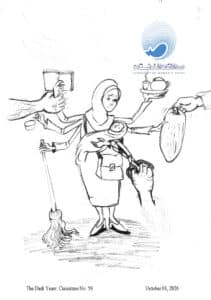
The problem, however, goes deeper. At the center of this paradigm stands a woman who neither speaks, nor hears, nor chooses. In the structure of the Persian ghazal, woman is consistently portrayed as the silent beloved, not as an autonomous human being, but as a symbol of beauty, delicacy, indifference, and distance.
The language of the ghazal excludes women from the realm of subjectivity, critical consciousness and independent will, and reduces them to “objects of love.” In the ghazal, woman never writes; she is always written. She shines in poetry, but not as a speaker or a decision-maker, only as the one about whom others speak.
In such a framework, woman is not the subject of the relationship but the projection screen for male desires. Her name remains unrecognised, her voice is silenced, her will absent, and her agency denied. This is symbolic violence enacted through beauty, a violence carried by rhetoric and aestheticisation. Reflecting on this reveals the hidden link between language and power. The very language that shapes culture with sweet expressions of love can, at the same time, take away women’s existence. This form of symbolic violence, without raising its voice or spilling blood, silences identities, erases memories, and hollows out the individual from within.
At the heart of this paradigm lies a metaphysical logic that privileges unity over diversity, silence over voice, and annihilation over persistence. The Persian ghazal understands love as “unity through the elimination of duality,” a unity in which one must vanish for the other to endure forever. This breaking of distinction does not serve the coexistence of differences, but the domination of one over the other and the erasure of the other.
Thus, the Persian ghazal has not created a connection between women and the public sphere of the polis, nor has it given them a place in political discourse. Instead, it has pushed them into the abyss of silence. For this reason, the ghazal cannot serve as a paradigm for popular politics, democracy, or governance based on human equality and pluralism.
The result of this paradigm shift is the emergence of a language which, while romantic in tone and gently acknowledging the presence of women, says nothing of their real struggles. It is a language that softly erases women, governs them through lyricism, and creates silence through love.
This erasure at the level of language symbolises the erasure in history and society. The women who are absent, nameless, and passive in Persian poetry are the same women who have been excluded from history, law, scholarship, and politics. The relationship between language and power is not decorative but structural. Language reproduces the memory of domination.
Is it possible to imagine a new paradigm of love in the Persian world based on human equality, ongoing dialogue, and the mutual subjectivity of both parties? Can the language of the ghazal be reshaped to make audible the silenced voices of women? This question may be left for another time. For now, we must ask: is it not time for the lyric paradigm of love to be subjected to a fundamental critique of its exclusionary structures?
Persian poetry, with all its brilliance, beauty, and allure, has been written over the graves of women whose presence in language is nameless, voiceless, and without rights. This is a suffering no beloved should have to endure. Until this language looks into the mirror of criticism and strikes at its own structures of exclusion, even the most beautiful romantic poem will remain a testimony to the history of silence and the erasure of women. This erasure is not the result of neglect, but the product of a deeply rooted ontological paradigm in the ghazal which regards individuality, difference, plurality, and equality as dangerous, while unity, silence, annihilation, and above all the invisibility of women are seen as virtues.
Editor’s Note: This article continues in Part IV
Note: The photo from Internet