In Iran, much of the work done by Afghanistani migrants remains largely unseen. From agriculture to small production units and factories, their labor quietly supports parts of the economy. Yet public narratives often portray them as burdens rather than contributors.
A report published by Radio Zamaneh on April 23, 2025, presents a different view. It notes that Afghanistani migrants generate substantial income for the state through formal processes such as residency renewals, work permits, and administrative penalties. According to the report, more than nine trillion tomans have been produced through these channels alone.
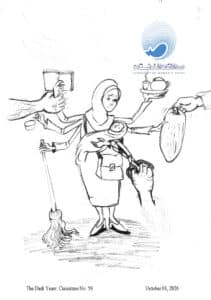
Within this already overlooked economy lies another layer that is even less visible: Afghanistani migrant women. Many work in fields, workshops, and factories. Others have begun building their own businesses, from physical shops to online enterprises. Some are breadwinners. Some are entrepreneurs. Some act as both worker and employer. Yet their role often remains overlooked.
For a short time, the digital economy appeared to offer new opportunities.
Those opportunities proved fragile.
During periods of domestic unrest, a twelve-day war, and a later conflict known as the Ramadan war, international internet access in Iran was repeatedly cut. At times, even domestic networks were disrupted. Each interruption brought digital activity to a halt. For Afghanistani migrants running online businesses, the impact was immediate.
It was in this context that Afghanistan Women’s Voice spoke to three Afghanistani migrant sisters who had been running a small online shop together. They are identified here as M.R., N.R., and M.R. One of them, M.R., spoke on behalf of all three. She holds a master’s degree in sociology and is now trying to pursue a doctorate degree.
“We were born here,” she said. “We live here. Only our parents were born in Afghanistan. They married here.”
All three sisters pursued higher education. One is currently completing an undergraduate degree. Another was preparing for university entrance exams, gained admission into an English program, but could not continue due to financial constraints. M.R. completed her studies at a university in Tehran and is now seeking further education opportunities.
Despite their qualifications, stable employment proved difficult to find.
“At first, they would accept us,” she said. “They would say everything was good. But once they realized we were Afghanistani migrants, it changed.”
In some cases, jobs were withdrawn. In others, work was carried out, but payment was never made. Without formal contracts or legal protection, there was little they could do.
“We could not just wait,” she said. “We had to find another way.”
The idea of starting an online shop came after a conversation with a friend. The suggestion was clear: create something of your own, be both employer and employee, and avoid dependence.
They began by thinking practically. The product needed to be durable, not perishable, and widely used. After careful consideration, they chose bags.
The next step was deciding where to sell them. Instagram seemed the most accessible platform.
Funding was a major challenge. Like many migrant families, they had limited savings and often reserved them for essential needs such as residency cards and work permits. Still, they managed to gather enough to begin.
To source goods, they travelled to wholesale markets in Tehran. There, they faced multiple challenges. Most traders were men. Some did not take them seriously because they were young. In some cases, they were charged higher prices due to inexperience. Storage areas also felt unsafe.
Transporting goods added further difficulty. They carried purchases to railway cargo stations, shipped them to Mashhad, and then travelled themselves. Collecting and transporting the goods again was physically demanding.
From the moment the idea first took shape to the point of actual execution, it took several months, from the spring of 2025, when the idea of the online shop came to us, to the end of that summer, when we finally launched it.
We faced many challenges along the way. It felt like going through the “Seven Labors of Rostam,” a phrase used to describe an extremely difficult and demanding process. In our case, we had our own seven stages.
The first was physical. Because we were women, carrying heavy goods was difficult for us.
The second was entering wholesale markets, which were mostly male-dominated. The warehouses where we shopped often felt unsafe, something that is not easy for women to navigate. The third challenge was not being taken seriously. Some wholesalers, seeing that we were young women, did not treat us with much importance.
The fourth was pricing. Because we lacked familiarity with the market, some sellers charged us higher prices. The fifth stage was technical. We had to learn how to run an online business, setting up an Instagram account, managing a page, creating content, running campaigns, and understanding marketing strategies. We had no prior experience in any of this, but we pushed through and learned as we went. Then came the sixth stage, building the business itself. It took a long time to launch the page and fully introduce it to customers. Creating an account, growing it, and gaining trust takes time. In the early days, you had to “warm up” the page slowly so that Instagram wouldn’t flag it as spam. Only after that can you begin to reach real customers and eventually move toward sales. And then came the seventh stage.
The internet was cut. It felt as though, just like in the epic when the White Demon overpowers Rostam, everything we had worked for was suddenly defeated. With the shutdown of international internet access, our online shop stopped.
“It felt like everything collapsed at once,” she said. Before that, their work had begun to take shape. At home, they photographed products, recorded videos, edited content, and posted it online. At first, most customers were relatives and acquaintances who visited their house. Gradually, orders began to come from a wider audience. Customers sent orders through Instagram messages. Payments, including delivery costs, were made via bank transfers. The sisters packaged the goods and sent them.
They named their shop Odybag, inspired by a white duck they kept as a pet. The duck became central to the shop’s identity, appearing in photos and videos and helping to attract attention.
They sold women’s bags in a range of designs and colors. The business began to grow.
“When we earned our own money,” she said, “we felt independent. We felt secure. We felt confident.” Then the interruptions began.
The first occurred during the twelve-day war, from June 13 to July 3, 2025. The second followed during unrest later that year. The third began in March 2026, during the Ramadan conflict, and continues to this day.
Each time, international internet access was cut. Instagram stopped working. Their shop became inactive. Sales dropped or stopped entirely.
“It was like a storm,” she said. “Like everything was turned upside down.”
They tried to use domestic applications, but the results were minimal. Customers trusted international platforms more. Domestic platforms had technical limitations and smaller audiences. Sales remained close to zero.
“I am not speaking about politics,” she said. “For us, the issue is losing our work. Our livelihood was taken from us.”
Before the shutdowns, their customers included both Iranian and Afghan clients from different cities, as well as a few from outside the country. That network was lost.
Orders remained unfinished. Communication was cut. It became impossible to continue normal operations.
“It was like the body was cut off from its circulation,” she said.
They also lost important opportunities, especially during holiday seasons when sales are typically higher.
There were further concerns around banking access. Migrants sometimes face blocked SIM cards and bank accounts. Restoring access requires obtaining a Foreigner ID and navigating lengthy administrative processes, often with uncertain results.
“If that had happened to us at the same time,” she said, “we would not have been able to continue.”
VPNs offered little solution. Initially, there was no way to bypass the shutdown. Later, VPNs were available but costly and unreliable. Running an online business requires a stable internet and high data usage. Even when they could connect, their customers often could not.
“We were cut off from everywhere,” she said.
In a single year, they had to start over three times.
“Each time it became harder,” she said.
The business had just begun to generate steady income when it stopped.
“It felt like it ended before it really began,” she said.
The impact was not only financial.
“We started with confidence,” she said. “But instability breaks that confidence.”
Now, even thinking about starting again feels uncertain. The future appears unclear, and each new effort carries risk.
Financial independence had been one of the most meaningful parts of their experience.
“When your income is your own,” she said, “you feel secure. You are not dependent.”
There is also the question of legal protection. Online businesses in Iran fall under several regulatory frameworks, including e-commerce and consumer protection laws. However, for migrants operating informally, especially through platforms like Instagram, there is little legal support.
Despite everything, she emphasized one point.
“Migrant voices need to be heard,” she said. “Especially women. Our story is only one example.”
Their online shop still exists.
But it no longer operates.
For now, it waits.
Photo credited: Internet