Reporter: Mahya Omid
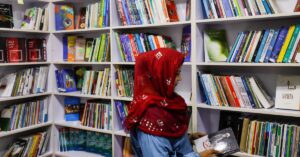
With the start of the new academic year in Afghanistan, girls above the sixth grade have been deprived of attending school for the fifth consecutive year. While school bells have rung in many cities, for thousands of girls, this sound is only a reminder of dreams left unfinished.
Negar, 18, a resident of Bamiyan, is one of thousands of girls whose prospects for the future were limited following the closure of schools. She says: “Before the Taliban, I was in the ninth grade. My father was a money changer, and we had a good life; but after the Taliban came, my father went bankrupt and we could no longer afford to live in Bamiyan. We were forced to move to Herat.”
Following the relocation, Negar faced depression and a sense of helplessness: “For the first year, I did not leave the house at all. I was under the care of a psychologist for six months and had weekly counseling sessions.”
Over time, and with the continuation of counseling sessions, her mental condition improved, and learning English became a strength in her life. Today, Negar is engaged in teaching English and computer skills at educational courses and online: “I spend my days working, and at night I attend online classes. I also continue my schooling online, and my morale has improved.”
However, the start of the new academic year is still accompanied by a sense of longing: “Online schools can never replace in-person classes. I did not only lose my school, but also my city and my friends. If the Taliban were not here, I would now be attending university. I hope I can obtain a scholarship through online schooling, but I do not know whether that is possible.”
Mojda, 26, who was a stomatology student at Herat University, says that these days university and her studies have become only a distant memory, and that the situation for girls is unjust and painful.
She adds: “I saw in the news that male students protested against the Taliban’s new regulation regarding growing beards and wearing traditional Afghan clothing and turbans. This issue made headlines across news outlets, but no one said that this year, as in previous years, schools and universities began without the presence of girls.”
Mojda has personally experienced the tangible differences between girls and boys: “A few days ago, I saw a new clinic in the city that bore the name of one of my male classmates. I cried all day for my own situation and for all girls. We used to study together in the same class; now he is a doctor and has his own clinic, while I am confined at home with an uncertain future.” She emphasizes that she was even willing to study while wearing a burqa, but being deprived of education has halted the course of her future
According to education experts and psychologists, being deprived of education has not only disrupted girls’ academic and career paths but has also negatively affected their hope, mental health, and outlook for the future.
Meanwhile, the girls of the Soozan Talayi Literary Association have symbolically held their online classes behind closed doors in protest of five years of mandatory school and university closures for girls.
In a statement, the association said: “This action is a voice against silence; a serious reminder to the people of Afghanistan and the world that, over these years, the girls of this land have been deprived of their most basic human right—the right to education.”
The Soozan Talayi Literary Association, operating under the supervision of Dr. Humaira Qaderi, a writer and university professor, has been providing storytelling education to girls and boys in Afghanistan for the past five years.
Ms. Qaderi explains that the main goal of this initiative is to maintain protest against the restrictions on women and girls in Afghanistan, so that their rights are not sidelined amid war and widespread poverty. She adds: “This protest is important both to attract society’s attention and for the girls themselves, so that they remain aware of their deprivation of rights and do not become accustomed to the current situation.”
Members of the Soozan Talayi Literary Association have called on all segments of society, especially men in Afghanistan, to stand with them and turn this protest into a collective demand.
They added: “Our wish is for a free and equal Afghanistan—a country where no girl is deprived of the right to education and no woman is sidelined. We strive for a future in which Afghanistan is recognized not by signs of discrimination, but by the values of justice, equality, and humanity in the world.”