Dossier of Afghanistani Women Fiction Writers (19)
Researcher: Qawm Shahi
Translator: Shekib Jaghori
The history of Afghanistani women’s fiction is not merely a history of literature. It is also the story of women’s voices, lived experience, and identity finding expression on the page.
For Afghanistani women writers, fiction has often carried purposes beyond art. It has offered a form of cultural resistance, a means of political endurance, and a way of asserting a female identity in a society where that identity has repeatedly been challenged.
Women protesting in the streets, women working through language and narrative, and women confronting oppression in every sphere are, in essence, part of the same movement. Each strives toward a common goal: preserving the female voice and securing recognition, visibility, and space to be heard that it has too often been denied.
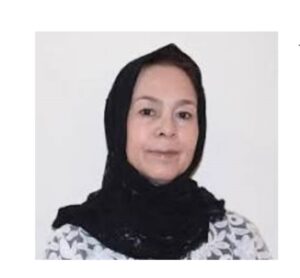
One such voice is that of Masouma Kawsari, an engineer and fiction writer.
In this installment of the series on Afghanistani women writers, we trace the life and literary journey of a woman whose work emerged from exile, conflict, and repeated displacement.
Writing Fiction
Masouma Kawsari is part of the generation of Afghanistani writers shaped by migration and exile. She is widely recognized as a prominent figure in Afghanistan’s contemporary fiction.
Some literary critics regard her as a natural storyteller, a writer whose talent appears to be instinctive rather than acquired. Her literary career began in the 1990s, a decade of upheaval and crisis in Afghanistan. The opening years of that decade remain among the most turbulent periods in the country’s modern history.
Competing ideological mujahideen factions turned their weapons on each other. The Soviet withdrawal in 1989 had already altered the country’s political trajectory. Five years later, in 1992, the Democratic Republic of Afghanistan, led by Dr. Mohammad Najibullah, collapsed. Kabul soon became the battlefield of rival armed factions, each fighting for power while the capital was torn apart by the fighting.
However, another story was unfolding outside Afghanistan.
Among Afghanistani refugees living in Iran, a generation of writers and intellectuals built literary and cultural institutions of their own. In the midst of exile and uncertainty, books were written, literary gatherings were organized, and creative work was sustained.
Kawsari began writing in exactly that environment.
Her earliest stories were written in 1992, the year the government of Afghanistan fell after losing the Soviet Union’s backing.
By 1995, Afghanistan was living under the shadow of civil war, institutional collapse, and a deepening humanitarian crisis. At the same time, a new force began to rise: the Taliban.
Over two periods of rule, the Taliban would dominate Afghanistan’s political life in ways that many citizens of Afghanistan believed halted the country’s social development. The movement brought a rigid interpretation of society and religion that reached into nearly every aspect of daily life. Afghanistan found itself increasingly isolated from the international community. Women were removed from public life and confined to domestic spaces.
Kawsari emerged from that decade. Her stories began to appear in refugee publications in 1995.
Although her published work is not extensive, she is regarded by many readers and critics as one of Afghanistan’s strongest fiction writers.
Her most important published work is the collection An Incident of the Season (Hadisa-e Fasl), released in Kabul nineteen years ago by the Zahiruddin Babur Literary and Cultural Association.
The collection centers on women’s lives. It examines restrictive traditions and narrates the suffering and discrimination experienced by women in Afghanistani society.
Literary critics have pointed to several distinguishing features of her writing: a clear and accessible prose style, an unwavering commitment to realism, and a sharp sensitivity to social concerns.
One example can be found in her story, Broken Flight.
Kawsari builds the narrative around two characters, a brother, and a sister.
The brother moves freely through the world. He leaves the house whenever he wishes. He roams wherever he pleases. He spends his time flying kites and exploring the outdoors.
His sister does not possess any of these freedoms.
This contrast is simple, but its implications are far-reaching.
Broken Flight is not merely a story about family relations. It is also a critique of culture, society, and politics. Through fiction, Kawsari subjects everyday inequalities to scrutiny. The result is a form of criticism that often reaches places inaccessible to journalists, historians, or essayists.
Kawsari’s work speaks for women and girls whose lives have long been circumscribed by forces beyond their control.
In Afghanistan’s deeply conservative society, particularly after the return of the Taliban Emirate, many women found themselves stripped of rights and opportunities that had once seemed within reach.
Kawsari’s fiction carries echoes of those experiences.
Education, Exile and Return
Higher education remains beyond the reach of many Afghanistani women of Kawsari’s generation. However, her path unfolded differently.
She belongs to a group of Afghanistani women who managed to pursue university studies despite the turbulence that has shaped much of the country’s recent history. Unlike countless Afghanistani girls whose education was interrupted by the Taliban rule, Kawsari spent much of her youth in Iran. Part of her life was shaped in the cities of Qom and Mashhad.
She completed her primary and secondary education in Mashhad and graduated with a diploma in natural sciences. In 1995, she returned to Afghanistan, a homeland that would remain central to her sense of identity but would never become a lasting place of comfort or security.
After returning, she enrolled in the Faculty of Engineering at the Balkh University in Mazar-i-Sharif. Kawsari is an engineer by training. Yet, before engineering became her profession, writing had already become part of her life.
Like many women around the world who have moved between technical disciplines and literature, she found a place in both fields. The relationship between engineering and fiction may appear unusual, but it is not unique to this case.
Among the writers often cited in this regard is Bandita Phukan, the Indian author who studied mechanical engineering before turning to fiction, novel writing, and translation. Another is Saleha Obaid, the Emirati writer with a degree in electronic engineering. The American novelist D. M. Pulley, known for works rooted in architectural history, also trained as a structural engineer.
The reason for drawing attention to such examples is clear. Afghanistani women possess the same intellectual and creative capacities as women elsewhere. Given the opportunity, they study, build careers, write books, and contribute to public life.
An Afghanistani woman can become an engineer, for example. She can become a novelist in the future. She can do both.
The obstacles have rarely been a lack of talent or ambition. More often, they come from political systems and social structures that restrict women’s freedom and narrow the space available to them.
Kawsari’s life reflects another possibility.
Engineering taught her to design structures. Writing gave her another craft to pursue. One dealt with buildings and their calculations. The other is with memory, imagination, and human experience.
Her stories are built with the same care that an engineer brings to a design. The materials are different. The purpose is different. Yet, both require vision and precision.
Migration
Kawsari’s life closely mirrors the experience of many Afghanistanis are forced from one country to another over the past four decades.
She was born in exile. She is both a refugee and the child of one. Much of her life has unfolded between departures and returns, between the hope of homecoming and the reality of her displacement.
Her story belongs to a generation for whom migration was not an event but a condition of their lives.
After spending her early years outside Afghanistan, she returned in 1995. The timing of this event is highly uncertain. Afghanistan was in the grip of a civil war. Mujahideen factions remain locked in struggle. An Islamist government led by Burhanuddin Rabbani was in power, while the Taliban advanced across the country.
Kawsari nevertheless chose to return. The return did not last.
In 1998, after the Taliban established control over much of Afghanistan, she was forced to go into exile and return to Iran.
This time, she settled in Isfahan. She did not spend those years in isolation. She worked with Afghanistani refugee children and taught them, remaining involved in the educational life of her community.
However, exile carries its own burdens. In 2003, she returned to Afghanistan for the second time.
She lived in Balkh and later in Kabul, attempting to build a life in the country she regarded as home. This effort proved difficult.
Over time, she came to a painful conclusion: Afghanistan could no longer provide the security, stability, and certainty she sought. The country she had returned to more than once was no longer a place where she could imagine a permanent future.
She left again. This time, she left for a long period.
The First Turning Point
The year 1973 occupies an important position in Afghanistan’s political history.
On the morning of 26 July 1973, the monarchy of Afghanistan was overthrown in a coup. The republic that followed marked the beginning of a new and turbulent political era.
Masouma Kawsari was born in that same year of rupture and transition. However, her birthplace lay beyond Afghanistan’s borders. She was born in the Iranian city of Qom in 1973, far from the country that would later become the central subject of much of her writing and experience.
The arc of her life would reflect many of the defining themes of modern Afghanistan history: exile and return, hope and disappointment, attachment to a homeland, and repeated separation from it. Her work emerged from these experiences.
Her stories belong to the literature of displacement, memory, and endurance that has shaped a large part of Afghanistan’s contemporary writing.
The Axe Bearers
The village is black behind the black blindfold.
The plain is black. The men carrying rifles are black silhouettes against the darkness.
Even so, I know them.
I know the men of the village. I know my brothers, my sons, my fathers, and grandfathers. I know the plain.
The plain has vanished beneath the shouting of men, as it vanished on the days, they played buzkashi. Sometimes, I wonder if the plain was created for that purpose alone.
The wind rises and pulls my chador toward the village. The village is on fire.
I walked through every burning alley. The women were running. All of them were conducted. They fled toward an open plain. Whether they were escaping the flames or the men, I cannot say.
I have lost the women in my village. Something tightened around my throat. I want to cry out. I want to call them by their names.
Nothing comes. Something is choking me. This has always been the case.
The women in my village have never been heard. They, too, have lost each other. They, too, cannot call across the distance that separates them from the world.
A voice says, “The first shot is mine.”
For years, they have struck me across the mouth. A moment later, I find myself staring into the barrel of a rifle. The man takes aim with one eye half open.
He has never looked at me with his eyes open. Perhaps he cannot see. The first bullet was fired.
In less than a heartbeat, a thousand images of my face splintered in the darkness, reflected inside a thousand rifle barrels.
The sound circles around my head. Blood dripped from my mouth. My tongue loosened and fell.
So, I had a tongue after all. The wind blows again. This time, I am lighter than I have ever been. Smaller than I have ever been.
Yet, the size of my shadow terrifies me. It has grown immense. It stretched across the plain and over the village.
My shadow settled on the shoulders of the village men. Its weight bends them down. Their shoulders crack under the weight.
I hear the breaking. I hear the men shouting. Men are always shouting. Their voices rise until I disappear within them.
When I was young and raised my voice, my mother would say:
“The deaf are the ones who shout. They cannot hear themselves and imagine no one else can hear either.”
My throat aches. Something is crushing it. Perhaps, a sip of water would help. The second shot comes. Then the third. After that I lose count. I tremble with terror. Not because I am dying.
Because I am not. I am afraid that I will remain alive. I am afraid that I cannot escape. The thirst remains with me. It draws nearer. Closer. Closer still. It wrapped itself around my throat.
The sky descends. Lower. Lower again. I lift my hands as if I can hold it back, as if I can stop it from collapsing on me. The plain shrinks. It becomes a cage. I strike its bars. I fall against them. I struggle. Far away, I see water.
I do not know whether I am flying through the sky or running across the earth. I only know that I must reach it.
When I arrive, I forget my thirst and my thirst is quenched. She is standing there. I know her, although the recognition comes from a distant place.
The fire that consumed the village burned away her chador. The wind carried away her white hair.
Her reflection lay on the still surface of the water. A thousand deep wrinkles creased her face and spread across the water like cracks. She does not look at me.
Her eyes were fixed somewhere beyond me, out on the plain, among the flames and the voices of men. Perhaps the thousand years of waiting have made her old.
A shot ring out. Pain twists through me. The lines on her face deepened. Her features tighten.
The water began to ripple. The mirage shivers. In each wave, the faces of the village girls are drawn downward and disappear beneath the surface. Another shot. And another. I fold into myself. The water trembles. The old woman trembles.
One by one, the girls vanished into the shifting reflections. The girls were from the village. The girls ran through the burning streets. The girls whose voices were never heard. The girls swallowed the shouting. My head rolled to one side. A strange calm arrives. The pain in my throat has disappeared.
The thirst is gone. Nothing chokes me anymore. I want to scream. I want to call the women of my village. I want to ask a question that has followed me throughout my life.
Why was I created? Then a voice answers. Not from the plain. Not from the men.
The voice seems to rise from inside me, as though it has struck the walls of my body and echoed back.
It says:
“Perhaps you were created as a target for the men of the village.”
I know that voice. It is my mother’s. She was the only one who ever had answers that satisfied me.
I say:
“Then I should have come into the world without life, like all the lifeless things made for the pleasure of the village men.”
No answer follows.
No echo returns. The plain trembles beneath the men’s cries. Their voices filled the air. Their shouting endures. And I remain. A target. A point at which they aim to achieve their goals. A mark left standing.