Revisiting the Lives of Influential Afghan Women – Part 3
Writer: Qawm shahi
Translator: Shekib Jaghori
Editorial Note: The Voice of Afghan Women is committed to presenting a different perspective through the series it has launched, including both« Influential Afghan Women »and« Afghan Women Story Writers.» In these collections, we seek to present Afghan women not merely as victims, oppressed, marginalized, or powerless individuals, but as active agents, holders of power, influential leaders and contributors who have shaped politics, society, culture and the economy.
The purpose of these narratives is not simply to recount the suffering, deprivation and injustice that Afghan women have endured. Rather, we aim to highlight their abilities, achievements, contributions and the influential roles they have played throughout Afghanistan’s history.
The Voice of Afghan Women believes that Afghanistan’s future cannot be shaped merely by recounting stories of pain, tragedy, misery and misfortune. It also depends on presenting role models—women who have reached positions of influence and made meaningful contributions in different spheres of life.
These women did not emerge from lives of privilege, comfort or what is commonly described today as a luxurious lifestyle. Rather, they rose from the heart of hardship, overcoming obstacles through determination and perseverance.
Our editorial policy, vision and mission are therefore clear: to introduce influential Afghan women who can inspire and serve as role models for both present and future generations.
At the same time, The Voice of Afghan Women does not seek to portray individuals in black-and-white terms. We do not believe that Afghans are either entirely good or entirely bad. In our view, every Afghan is a human being with strengths and virtues, as well as flaws and shortcomings and deserves to be understood in that complexity.
For us, the essential measure is whether a person has believed in and remained committed, both in the past and in the present, to human rights, democratic values, and the principles of the modern world, including the Universal Declaration of Human Rights and international human rights treaties. That is the standard we value and uphold.
In the first two articles of our Influential Afghan Women series, we revisited the lives of Arbab Khadija and Dr. Sakina Yaghoobi, presenting Afghan women from another perspective—one of leadership, competence, influence and even charisma.
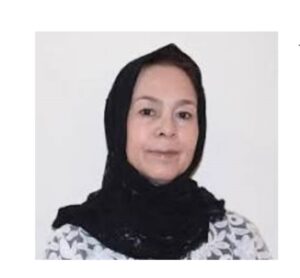
We now turn to Dr. Anahita Ratebzaad, one of Afghanistan’s leading leftist figures. From serving as Vice President to representing the people in Parliament and later serving as an ambassador, she established herself as a powerful and influential figure in politics and other areas of public life.
Dr. Anahita Ratebzaad is one of the most well-known Afghan women politicians of the 20th century. She was a politician, a public figure, a physician, a women’s rights activist one of the founders of the People’s Democratic Party of Afghanistan, and one of the political leaders of the Parcham faction of the party. She was also among the founders of the Democratic Women’s Organization of Afghanistan.
She was one of the first female members of the Afghan Parliament and later served as Vice President, Minister and Ambassador. She was also one of the prominent socialist and Marxist–Leninist leaders in Afghanistan and a supporter of secularism.
Political Career
Founder of the Democratic Women’s Organization of Afghanistan: Between 1964 and 1965, the Democratic Women’s Organization of Afghanistan was established as the first large-scale women’s organization in Afghanistan affiliated with the leftist movement, with Anahita Ratebzad serving as its leader.
This was a significant development that helped create a foundation for democratic participation in Afghan society, particularly for the women of Afghanistan.
Founding Member of the People’s Democratic Party of Afghanistan (PDPA):
In 1965, Afghanistan was experiencing a period of constitutional monarchy and what was known as the« Decade of Democracy.» During this period, political reforms, relative freedom of the press and the growth of leftist, Islamist and nationalist movements took place.
In the same year, an event occurred that would alter the course of Afghanistan’s political history for many years to come. On January 1, 1965, a group of intellectuals, including Nur Mohammad Taraki, Babrak Karmal, Anahita Ratebzaad, Sultan Ali Keshtmand and Hafizullah Amin—27 individuals in total—secretly founded the People’s Democratic Party of Afghanistan at Nur Mohammad Taraki’s home in Kabul.
In this way, Anahita Ratebzaad’s membership among the founding members of the People’s Democratic Party of Afghanistan became one of the significant chapters of her political career. The party went on to become an important part of Afghanistan’s political history.
Expanding education, fighting illiteracy, promoting equal rights for women and men, reducing the influence of the feudal system and establishing a socialist state were among the goals outlined in the party’s manifesto.
Therefore, Anahita Ratebzad can be considered one of the influential political figures in contemporary Afghan politics—a woman who stands among the leaders of change in Afghanistan.
The party of which she was one of the founders played a central role in the fall of the existing political system and the establishment of the Democratic Republic of Afghanistan.
Member of Parliament:
Under the 1964 Constitution, Afghanistan’s constitutional monarchy expanded the powers of Parliament. For the first time, women were granted the right to vote and were able to participate in parliamentary elections.
From 1965 to 1969, Anahita Ratebzaad was elected to the House of Representatives from Kabul’s Second Urban Constituency. She entered Parliament alongside three other women representatives: Khadija Ahrari, Masoumeh Esmati Wardak and Roghaye Abu Bakr.
Minister of Social Affairs:
In 1978, following the rise to power of the Khalq government under the leadership of Nur Mohammad Taraki, Anahita Ratebzad became the only woman to serve in Taraki’s cabinet. She was appointed Minister of Social Affairs.
Ambassador of Afghanistan to Yugoslavia:
From 1978 to 1980, Anahita Ratebzad served as Afghanistan’s Ambassador to Yugoslavia, based in Belgrade. With this appointment, she became the first woman to serve as Afghanistan’s ambassador.
Member of the Political Bureau of the People’s Democratic Party of Afghanistan (PDPA):
From 1979 to 1986, after the Parcham faction came to power, Anahita Ratebzad became a member of the Political Bureau of the People’s Democratic Party of Afghanistan (PDPA), the party’s highest decision-making body.
During this period, she was one of the prominent figures in Afghan politics and played an influential role in the country’s political leadership and decision-making.
Minister of Education:
During the government of Babrak Karmal, Anahita Ratebzaad served as Minister of Education from 1980 to 1981. At the same time, she supervised the Ministries of Information and Culture, Higher Education and Public Health.
She also served as a permanent member of the Political Bureau of the People’s Democratic Party of Afghanistan (PDPA).
Vice President (Vice Chair of the Revolutionary Council):
From December 27, 1980, to November 24, 1985, Anahita Ratebzaad served as Vice President of the Democratic Republic of Afghanistan and Vice Chair of the Revolutionary Council. She became the highest-ranking woman to hold public office in Afghanistan’s history at that time.
Following the rise of Dr. Mohammad Najibullah to power and the political changes within the government, she was eventually relieved of all her official positions.
Activities in the Field of Women’s Rights:
Anahita Ratebzad can be considered one of the pioneers of women’s rights activism in Afghanistan. In 1964, she founded the Democratic Women’s Organization of Afghanistan together with a number of like-minded colleagues and became its leader.
Through this organization, she focused on expanding education, promoting literacy, and increasing women’s participation in society. Ratebzaad also organized the first official celebration of International Women’s Day on March 8, 1965, in Kabul.
She was one of the advocates of secularism in Afghanistan. Her focus was on women’s education, women’s participation in public life, employment opportunities, and legal equality.
Some researchers of Afghan women’s history consider Anahita Ratebzaad one of the pioneers of women’s political participation in Afghanistan. Therefore, in terms of historical significance, she is regarded as one of the first influential women in Afghan politics.
The Historical Significance of Anahita Ratebzad
Two Lives and Two Ways of Thinking: Ideological Thought and Secularism
Anahita Ratebzad’s life reflects two different approaches and ways of thinking: ideological thought and secularism. If the ideas and goals of the Democratic Women’s Organization of Afghanistan had expanded, women would certainly not have faced the conditions they experience under the Taliban today.
Gender equality in terms of rights, the influence of secular ideas and the creation of a progressive and free society could have been achieved. However, ideological thinking became dominant.
With the support of countries opposed to the Soviet Union, an ideological jihadist institution emerged. According to Milton Bearden, the former head of the CIA’s support program for the Afghan Mujahideen in Pakistan, in 1986, under the direction of William Casey, the then Director of the CIA, Milton brought one billion dollars and Stinger missiles into Afghanistan in order to destroy the foundations of socialism and progressive secular ideas—and succeeded in doing so.
Anahita Ratebzaad was a secular woman. Enlightenment, raising awareness and organizing the women’s movement were among the important aspects of her work.
If Anahita Ratebzad’s ideas had expanded and gained wider influence, an atmosphere of repression such as the period under the Taliban would certainly never have emerged in Afghanistan.
Anahita Ratebzaad’s progressive views and positions faced challenges from conservative and Islamist forces. These conservative forces were supported by powerful financial resources and a large economy, including the wealth generated from oil fields in Saudi Arabia and other oil-rich Muslim countries.
Hamed Abdul-Samad writes in his book The Decline of the Islamic World:
« Political Islam was losing its influence until the beginning of the 20th century. Then, the discovery of oil and the enormous revenues it generated, particularly in Saudi Arabia and the Gulf countries, created the possibility of exporting and expanding Islamist ideologies. Oil wealth played an important role in financing mosques, religious schools, universities and networks of religious outreach throughout the Muslim world.» However, today, under the rule of the ideological Islamic institution led by Mullah Hibatullah Akhundzada, women have no meaningful role in social and public life. They have been deprived of the right to travel, the right to benefit from human rights values, the right to employment, the right to equality with men, the right to political participation, and the right to work, as well as many other basic aspects of life.
Education:
Anahita Ratebzaad completed her secondary education up to the eighth grade at Malalai High School in Kabul in 1945. She then received one year of nursing training at a midwifery training institute in Kabul in 1947.
In the same year, she married Dr. Keramuddin Kakar. In 1949, she traveled with her husband to the United States, where she continued her education in the field of nursing.
After returning to Afghanistan, she was appointed as the director of Masturat Hospital. At the same time, she taught midwifery at the Kabul Midwifery Training Institute.
In 1957, she entered the Faculty of Medicine at Kabul University, and in 1963, she earned her Doctor of Medicine (MD) degree from Kabul University. For this reason, she is also recognized as one of the first female physicians in Afghanistan.
Personal Biography:
It was November 1, 1931, during the centralized monarchy of Mohammad Nadir Khan. Afghanistan was going through a sensitive period in its history. It was a time of political reconstruction, two years after the fall of Amanullah Khan’s government and the defeat of Habibullah Kalakani.
The scars of civil conflicts were still visible across the country when Anahita was born in the home of Ahmad Rateb, a journalist and a supporter of the Amanullah reforms.
Ahmad Rateb, Anahita Ratebzaad’s father, was the nephew of Mahmud Tarzi. He played a significant role in drafting Afghanistan’s first Constitution in 1923.
During those years, he published the weekly newspaper Nasim-e Sahar, an independent publication owned and edited by Ahmad Rateb, Anahita’s father. During the Amanullah era, the newspaper promoted ideas of constitutionalism and reform.
The publication began its activities on January 27, 1928, and was suspended after 15 issues due to the publication of critical articles.
After the fall of Amanullah Khan, Ahmad Rateb was exiled to Iran, where he later passed away. Anahita and her brother grew up in difficult financial circumstances and without their father’s presence.
In short, Anahita was the daughter of an intellectual father who was among the pioneers of change and reform.
The Final Years of Her Life:
The story of Anahita Ratebzaad’s life has a tragic ending. After Dr. Mohammad Najibullah came to power, she was removed from the political scene.
In 1992, following the collapse of the People’s Democratic Party of Afghanistan (PDPA) government and the beginning of the devastating conflicts among ideological Mujahideen groups, she was forced to leave Kabul.
In 1995, she moved to Sofia, Bulgaria, where she stayed for some time. Then, in 1996, she went to Germany, where her asylum request was accepted.
She settled in Lünen, in the state of North Rhine-Westphalia and later lived near Dortmund. However, some sources have reported that she first went to India to stay with her family and then traveled to Sofia.
Finally, Anahita Ratebzaad passed away on September 7, 2014, in Dortmund, Germany, due to kidney failure. Her body was returned to her homeland, where she was buried in Shuhada-e Salehin Cemetery.
A woman whose name once represented power and authority, and who was one of the most influential voices in politics and women’s rights, as well as one of the most recognized female politicians of 20th-century Afghanistan — her story has now come to an end.
May her soul rest in peace.