Tales of the Dark Age (No. 102)
By Hedieh Ahmadi
It was the last days of autumn, and Mahbubeh was slowly approaching her ninth birthday. Nine is the age of childish games and hobbies—not of carrying the burdens of life. Yet destiny had written a sad story for this little girl: a story of forced marriage.
Mahbooba was a resident of Daikundi. She was born into a very poor family. Her father was a man with many hardships—he was blind and in poor health. Yet he had a big, kind heart, always giving his children hope that one day their fortunes would change.
Doctors had said that his condition was treatable and that he was not congenitally blind. But treatment was very expensive. And when the pockets are empty, even hope becomes distant and unattainable.
Mahboobeh’s father, Khodadad, was the head of a family of eight, including two daughters and four sons. Mahboobeh, as the eldest daughter, suffered the most from her father’s blindness. Seeing that he could not even walk a meter without help made her even more despondent. She asked herself, “Will my father be able to see tomorrow?”
But there was no one to give her hope. With her father’s hands clasped and his blind eyes, could anything be done?
On the other hand, Mahbubeh’s mother, Tahira, was an unkind and ill-tempered woman. She never paid attention to Khodadad. Sometimes, she even mocked him, calling him “blind.”
When spring arrived and the cultivation season began, Khodadad and his eldest son, Ali Asghar, went to work on the villagers’ lands. Yet the results of their labor were very meager.
Ali Asghar, who had taken on the responsibilities of the family after his father’s blindness, was unable to attend school or continue his studies. It seemed that his father’s blindness and the hardships at home had also weighed heavily on his spirit. Sometimes, he would simply look at his father in silence, perhaps out of frustration. Out of necessity, he became a shepherd for the neighboring flocks.
Mahboobeh grew a little older. Instead of pens, she became familiar with cooking utensils and oven skewers. Instead of schoolbooks, she had to learn household chores.
Gradually, a suitor was found for her. When the first suitors came, her father and family did not agree. They said, “Our daughter is still a child; she is not yet ready to face the challenges of life.”
But when Mahboobeh saw her family in a state of frailty and helplessness, she feared that they would force her into marriage.
Mahboobeh was relatively short in stature, with a thin and weak body, brown eyes, and a long nose. She was so frail that some people jokingly said, “If someone holds your hand tightly, it will break; and if they grab it by your nose, it could kill you.”
Sometimes Mahboobeh would go with the neighboring girls for play and fun, and her sorrows would lift for a moment. But when she returned home and saw her father, all the hardships came rushing back.
She was overwhelmed. With a blind father and no proper means to support the family, what could she do? On the other hand, when she saw girls her age going to school, she would weep. She whispered to herself:
“What if You could make my father see?
What if I could go to school like other girls?
Couldn’t my father also be rich and buy me pens and notebooks?”
By the misfortune of life, Khodadad, in addition to being blind, also suffered from diabetes. Now the darkness in his eyes seemed even heavier. Most days, he would kneel in grief, sitting by the wall as if it were his place. Blindness and diabetes had weighed so heavily on him that anyone who saw him felt their heart ache for him.
The burdens of life were growing heavier day by day over the members of Khodadad’s family—over the daughters, the sons, and even his wife. On one rainy day, Tahira, Khodadad’s wife, held her forty-day-old baby in her arms, sitting by the window and breastfeeding him. The sound of the rain made her sorrows feel even fresher. She stared at the drops sliding down the glass and whispered to herself:”How did life drape my heart in such a black garment?
Why has everything become void of the color of hope?
Why is my share so much silence and hardship?”
Tahira could no longer bear it. She was exhausted by life, by poverty, and by her blind husband. Finally, she made her decision—she left the house. She went with Jahangir, Ahmad, and Mohammad, not even taking her phone with her. She wanted to go somewhere where she would see no one, not even Mahboobeh or Ali Asghar.
A month later, news came that she had been seen in Kandahar. She no longer checked in or contacted anyone. She was tired—tired of everything.
At home, Mahboobeh stayed with her siblings and her blind father. She had not yet learned to bake bread. All she could do was knead the dough, while the neighbor’s wife baked the bread for them.
Her father’s condition was getting worse day by day. A kind neighbor took him to a doctor. He received medicine and improved slightly, but he never fully recovered.
The people of the village were ignorant and opportunistic. Another suitor was found for Mahboobeh. This time, her father made a difficult decision—he gave her away in marriage.
When he told Mahboobeh of his decision, the girl only looked at her father’s tired face. Tears welled up in her eyes. Her throat tightened. She thought about her own fate—about the fate of women who do not even have a choice.
Sattar, the man who was to become the husband of 10-year-old Mahboobeh, was not mentally stable. He would laugh for no reason. He could not walk properly and had a congenital disability. His age was nearly three times that of hers.
Finally, in the absence of her mother and in the darkness of her father’s eyes, the wedding was set for the following night. Mahboobeh still did not understand what “husband” meant, or what responsibilities life would bring. Everything seemed like a distant and incomprehensible fairy tale to her.
On the night the groom’s family came to take her, her aunt tried to prepare her. At that moment, Mahboobeh’s body began to tremble. The world darkened before her eyes. She threw herself into her aunt’s arms and cried bitterly.
She said:
“Aunt, I don’t want to go. I want to stay with my father. My father cannot see…”
Her aunt was crying too. She said nothing. She took Mahboobeh to the bathroom and washed her thin, fragile body. Then she dressed her in new clothes and combed her hair. Mahboobeh was still crying:
“Auntie, I don’t want to go to anyone’s house. I want to stay with my father. I will take care of Ali Asghar and Narges…”
Then she said in a broken voice:
“If my father doesn’t want me, I will go to my mother… Please, aunt…”
It was night. Six people had come: the groom, his sister, his parents, the mullah, and a driver with a van. Everything was prepared. But Mahboobeh was nowhere to be found—as if she had vanished into thin air.
She had escaped.
Her father was unable to move. The half-conscious groom, along with her aunt’s husband, went out to look for her.
In the darkness of the night, beneath a mountain, Mahboobeh had fallen asleep under a rock. Suddenly, she was struck in the face. She woke up to Sattar’s blows, confused, finding herself between two angry men. Half-asleep and half-awake, she cried out:
“Mother… I’m not going…”
But there was no escape. A firm hand gripped her wrist, and she was forcibly taken back home.
When she entered, her mother-in-law slapped her hard across the face. She hit the wall and fell. Then a few ornaments were hung on her hands and around her neck. Her body went limp. She no longer cried or spoke.
They threw a veil over her head—a tent that swallowed her childhood, a tent that turned her freedom into a prison.
“The marriage has been announced,” the mullah declared loudly.
Her father sat quietly in a corner, just listening. What a heavy moment it was.
That night, Mahboobeh could not sleep. Her eyes were red from crying.
In the morning, it was time to leave. She stared at her bracelets and rings. It was as if she saw her life in those circles—closed, tight, with no way to escape.
Her tears flowed slowly, but she made no sound.
They took her away.
On the way, she fell into a deep, heavy sleep, one that felt like unconsciousness. When she opened her eyes, her head rested in her aunt’s lap. Everything felt alien. She closed her eyes again, letting her tears flow gently onto her aunt’s lap.
In the morning, in the corner of the room, he knelt on his knees—like a bird with broken wings. It was painful. He writhed in pain. His dreams had been reduced to dust. He said nothing more.
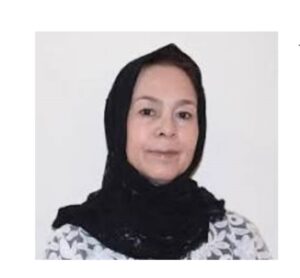
Photo credited: Internet